
The plan
This is our active plan for MOCSI including investor decks, financial models, and site research. It's rebuilt regularly from weekly working sessions, active Slack discussions, and new information we receive. We are showing our work so that neighbors, funders, and other communities can follow along and reuse what's useful.
The most recent release is 0e13319 (November 2026).
What MOCSI is
MOCSI is building AI compute that public-interest institutions can trust: open-weight models we host ourselves, on hardware we run, in a data center where the host community is a stakeholder. It is a project of Public AI, fiscally sponsored by Metagov.
Four commitments define the product: open weights we self-host; transparent model and location provenance; auditable answers in that narrow sense; and community governance of the host facility. Pricing is competitive—customers choose us for an inspectable stack, not a race to the bottom.
Three projects
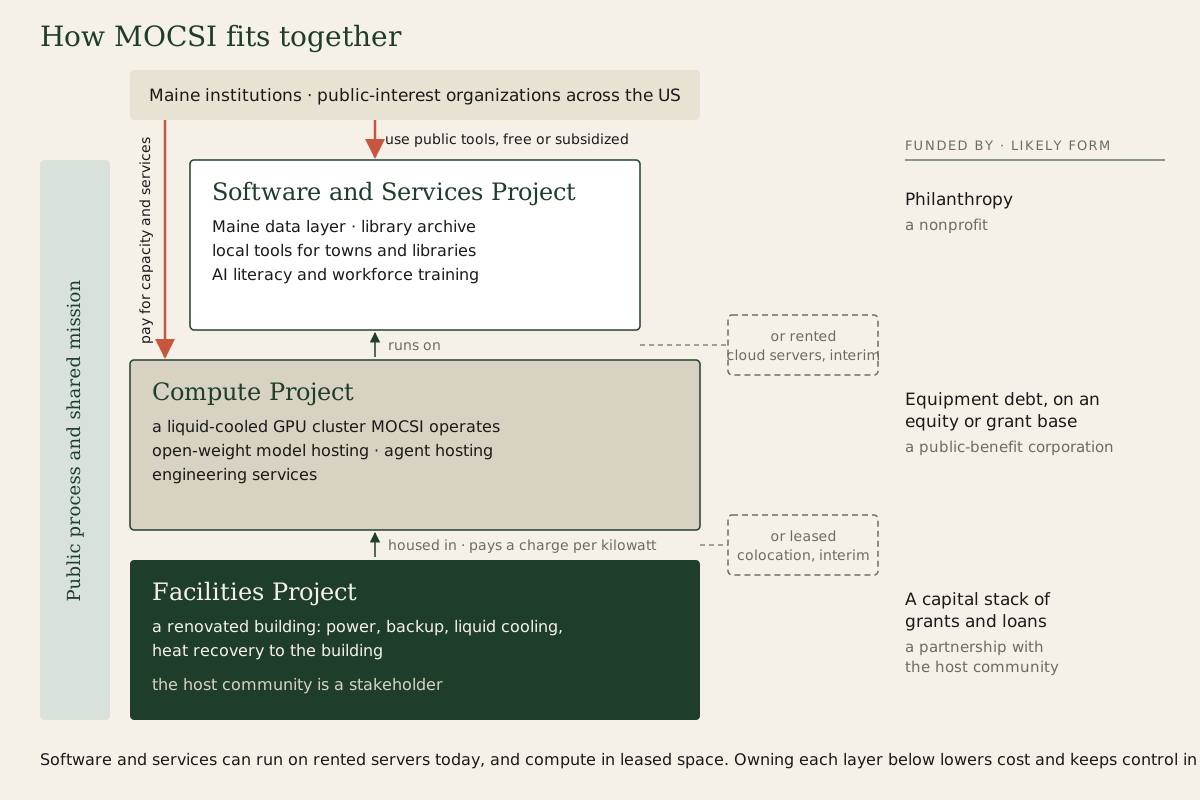
The work splits into three tracks with different funders and likely legal forms. Upper layers can run on rented substitutes until the layer beneath them is ready.
- Software and Services — applications, assistants, agent hosting, and engineering for Maine institutions and public-interest buyers.
- Compute — a liquid-cooled cluster of used NVIDIA datacenter GPUs (64 at launch, growing toward 96), financed as equipment.
- Facilities — electrical service, backup power, and cooling in a renovated Maine building where the host community holds a stake.
Sites we have researched
No permanent site is selected. These are places we have done desk research, visits, or both. Permanent-home criteria include community stake in the facility; some sites below are only candidates for interim hosting.
| Site | Role under study | Notes |
|---|---|---|
| Van Buren Connectivity Center / planned Community Innovation Hub (Aroostook County) | Permanent-home candidate under study; Phase 1 pilot in the existing Connectivity Center is also under discussion | Municipal utility (Van Buren Light & Power). Town is advancing a connectivity hub with partners in Fort Kent and Fort Fairfield. Facility upgrades for a full build are modeled separately (mid ~$2.05M; range ~$1.03M–$3.85M). Conversations with the town are ongoing. |
| Brunswick Landing | Interim host for one ~8-GPU / ~10 kW IT server (least capital paths) | Campus includes a FirstLight data center (published ~12–15 kW/rack class). Does not meet the community ownership gate for a permanent home. Field work (landlord, zoning, fiber, rates) still open. |
| Former Loring AFB campus (Limestone) | Interim / colo pilot candidate | Public reporting describes a LiquidCool-oriented data center project on the campus. Under evaluation as an existing-facility path while a community-owned permanent home is built. |
| 340 Cumberland Ave, Portland (CENTRA / PWM1) | Evaluated; not a permanent-home candidate | Carrier hotel / colo with strong interconnect. Strong on time-to-market and redundancy class; does not offer host community ownership of the facility, which disqualifies it as a permanent home under current criteria. Earlier colo quote is expired and undersized for the current fleet plan. |
| Houlton, Calais, Madison (and similar towns) | Candidate class, lighter diligence | Same shape as Van Buren: municipal or cooperative utilities. Tracked as the broader class of towns that could meet the community-stake requirement; not fully diligenced as Stage 1 sites. |
Compute ask (mid-case)
Used NVIDIA datacenter GPUs in eight-GPU servers, liquid-cooled: 64 GPUs at launch, growing toward 96 by year 4. Hardware model at purchase is not locked; the workbook prices H100 then H200 as the current basis.
| Item | Mid-case figure |
|---|---|
| Financing sought (launch hardware + working capital) | $2.14M |
| Six-year modeled revenue | $11.55M |
| Revenue per $1 of operating + hardware cost | $2.15 (facility grant-funded case) |
| Lowest modeled year-end cash after loan payments | $1.16M |
Full tables and assumptions are in the financial summary PDF and the compute workbook in the package. Demand is largely modeled; we do not yet have founding term sheets.
Facility upgrades (separate project)
Electrical service, backup power, and liquid cooling for a ~110 kW design load. Planning estimates from list prices and trade guides—not budgetary quotes.
| Subsystem | Mid | Range |
|---|---|---|
| Electrical service and distribution | $695k | $313k–$1.43M |
| Backup power (generator + UPS) | $443k | $291k–$664k |
| Liquid cooling plant | $910k | $422k–$1.76M |
| Total | $2.05M | $1.03M–$3.85M |
If a grant funds the facility, the compute pays about $598/kW-yr on design capacity; if financed over 20 years at 8.5% (assuming a loan guarantee), about $2,541/kW-yr. Equipment renewal after year 6 is largely unfunded in the current charge—see the facility renewal note inside the package zip.
How to build a data center
These are the same materials we use to plan MOCSI. If you are scoping a community-scale compute facility somewhere else, start with the public deck, the financial model, the decision log, and the open questions—or download the November 2026 package (zip) and read everything. Figures will keep changing.
Agent prompt (expand)
Place: [your region or community]

Help me plan a MOCSI-style pilot-scale AI compute package for the place above.

1. Download and unpack https://publicai.us/mocsi/mocsi-package-november-2026.zip.
2. Read everything in the package (summaries, both workbooks, decision log, open questions, current state, and the rest).
3. Treat all figures as mid-case planning estimates, not quotes, not audited financials, and not an offer of securities.
4. Adapt the pilot-scale plan to that place.
Get in touch
Questions, partnership ideas, or feedback on the plan—we want to hear from you, whether you are a funder, a Maine institution, or someone adapting these materials for another place.